You wrote-: "All parts. Per 1-L #6, "The [Sweetspot (which replaces the Clubshaft per 2-F)] always the points at the Plane Line except when they are parallel to each other".
From my perspective, the sweetspot and the clubshaft are on the same plane when the clubshaft is above waist level (above the third parallel).
Wherever the 'joining' (of Clubshaft and Sweetspot Planes) occurs, the Shaft has moved off its own Clubshaft Impact Plane and onto the Plane of the orbiting Sweetspot. In the 'un-joining' (Release), it moves off the Sweetspot Plane and back to its own Impact Plane.
Originally Posted by Jeff
Therefore, during the early-mid downswing, the butt end of the clubshaft points at the ball-target line (as if the club is merely a dowel stick without a clubhead). Therefore, I "feel" as if it is the clubshaft that points at the ball-target in the early-mid downswing.
You "feel" this because that is exactly what is happening. During the Backstroke, the Clubshaft and Sweetspot have become one.
Originally Posted by Jeff
From the delivery position to impact, a golfer simply performs a release swivel action that squares the clubface. I do not believe that a golfer can change his on-plane condition after the golf club has passed the third parallel position without "steering". I believe that if I am not perfectly on-plane by the time my clubshaft reaches the third parallel position, then it is too late to alter my imperfect off-plane condition.
While your words read more like a Golfer's Creed -- This I Believe -- than a scientist's hypothesis http://en.wikipedia.org/wiki/Hypothesis, you are correct. The orbiting Sweetspot dictates the precise Plane of Motion. The intersection of that Inclined Plane (of the Motion) and the Horizontal Plane (of the ground) establishes the Base Line of that Plane, i.e., the Sweetspot Plane Line. It is this Line that the orbiting Sweetspot traces. The Release Swivel that "simply . . . squares the Clubface" -- andsimultaneously produces the Maximum Transfer Power of the #3 Accumulator and assures Rhythm (6-B-3-0/A) -- alsorotates the Clubshaft around the Sweetspot. Thus, the Release Swivel prepares and enables the Clubshaft for its own tracing through Impact of the Clubshaft Plane Line.
Originally Posted by Jeff
Also, the absolute difference between the base of the clubshaft hosel plane and the base of the sweetspot plane reaches a maximum value of about 2" at impact and decreases to zero at the 3rd parallel and 4th parallel conditions. That results in only a small angular difference in inclined plane between the clubshaft plane and sweetspot plane in the impact zone (and which only exists to a significant degree within a distance of about 12" behind/in front of the ball) and that very small difference is something my brain automatically computes on a subconscious level.
Conceptually, no new news here (but I appreciate your quantifications and will accept your word for them). We are agreed on these two points:
Fact: The Sweetspot resides outside the hosel at Address and Impact.
Fact: During the Stroke, they often occupy the same Plane.
Therefore, one of two conditions must exist:
Door #1. The hosel is rotating to accomodate the Sweetspot's orbit; or
Door #2. The Sweetspot is rotating to accomodate the hosel's orbit.
Yoda - my answer is neither 1 or 2 in terms of keeping the clubshaft on-plane. My answer is 1 when it comes to hitting the ball with a square clubface. Both the sweetspot and hosel rotate at the same rpm, but only the sweetspot hits the ball.
The way you worded/posed your latest question made me think of this quandary in a different way. You used the word "accomodate" and it changed the way I think of the situation. I think that there are two factors in play.
Factor 1.
Moving the clubshaft in space in a certain way (on-plane) so that one can create an overall club shaft arc that is symmetrical to the ball-target line, and that will allow the clubshaft arc to be in-to-square-to-in with respect to the ball-target line. If one was using a dowel stick (equivalent to a clubshaft without an attached clubhead), then one could paint the last 2" of the peripheral end of the dowel stick red, and the idea would be that one would want to get the red area of the dowel stick square to the ball by impact.
Factor 2.
The clubhead is an attachment at the end of the clubshaft that extends out at roughly a right angle relative to the peripheral end of the clubshaft and a golfer wants to hit the ball precisely in the center spot of that extension (which we call the sweetspot). Presume that the clubhead width is 4" and that the sweetspot is extended 2" away from the peripheral end of the clubshaft (which we call the hosel).
An experienced golfer knows that while he is swinging the clubshaft around his rotating torso with his swinging arms, that he needs to rotate the clubshaft in space in order to keep the clubshaft on-plane throughout the downswing. Now (when a clubhead is attached at right angles to his clubshaft) he is faced with a second need - he needs to square the sweetspot at impact. A golfer knows that his clubshaft will undergo a 90 degree rotation between the delivery position and the ball. He also knows that he must get the sweetspot (which is extended 2" away from the end of the clubshaft) to hit the ball squarely. He therefore has to adjust his swing to accomodate that specific need. In other words, he needs to stand 2" further away from the ball so that the sweetspot (and not the peripheral end of the clubshaft) hits the ball. He then performs the identical swing as before, and the clubshaft still rotates 90 degrees between the 3rd parallel and the ball, but because he is standing 2" further away from the ball, the hosel will end up being 2" away from the ball when the peripheral end of the clubshaft is square to the ball-target line. By making that accomodation, the sweetspot will hit the ball squarely. In other words, the golfer had to allow the hosel to accomodate to the need of the golfer to get the sweetspot to hit the ball.
If one considers the geometry of this accomodation, note that the front of the hosel rotated to exactly the same degree as the clubface (sweetspot) between the 3rd parallel and impact because they both rotate equally as much as the back of the left hand rotates, and that the hosel doesn't rotate around the sweetspot (nor does the sweetspot rotate around the hosel because they both rotate at the same rpm as the back of the left hand between the 3rd parallel and impact). In fact, the hosel should transcribe exactly the same-shaped orbit it produced when there was no clubhead attached to the end of the clubshaft. However, the entire hosel orbit had to move in space to ensure that the sweetspot (of the extension piece that is at right angles to the end of the clubshaft) hits the ball squarely. In that sense, the hosel is accomodating to the sweetspot's orbital arc.
If the golfer then replaced his 4" wide clubhead with a new clubhead that had a width of 6" (which means that the sweetspot is 3" away from the hosel) then the golfer would have to accomodate himself to that fact. He would keep his overall clubshaft orbit the same, but he would have to stand another 1" further away from the ball to ensure that the sweetspot of the 6" wide clubface hit the ball squarely. So, in that sense the hosel is accomodating to the needs of the sweetspot to swing in an circular arc that allows the overall sweetspot arc to be in-to-square-to-in and that also allows the sweetspot to hit the ball squarely. However, that accomodation doesn't require that the shape of the clubshaft's orbit be altered when the clubhead width changes from 4" to 6". Also, the clubhead shaft will still remain on-plane during its travel through the impact zone, and it will still track along the same inclined plane between the 3rd and 4th parallel positions.
The idea of the hosel rotating around the sweetspot (or vica versa) would only have "relevance" if they rotated at a different rpm between the 3rd parallel and impact or between impact and the end of the followthrough.
As you are driving a tractor (hosel) pulling a heavy trailer (clubhead) along a straight road (swing path) seeing a big golf ball in the middle of the road ahead and you want to smack the golf ball with the side of the trailer. How would you do it?
1) Don't aim for the golf ball but drive straight keeping left of the road; turn sharply left the last moment.
2) Drive straight for the golf ball and turn sharply left the last moment.
I think that your tractor trailer analogy has no relevance with respect to the release swivel action for the following reasons.
1) In your tractor trailer example you are trying to hit the golf ball with the side of the trailer, but there is a flexible joint between the tractor (hosel) and the trailer (clubhead) that allows the angle between the tractor and trailer to vary. By contrast, in a release swivel action, the angle between the hosel and the clubhead is fixed, and not flexible and the clubface angle changes relative to the ball-target line because the entire clubshaft and clubface rotates 90 degrees as a single unit while the left wrist uncocks - and the rpm of the clubshaft hosel is identical to the rpm of the clubface's sweetspot and equal to the rpm of the flat left wrist/hand unit.
2) To think of a comparable analogy, I think that you need to think along the following lines. First eliminate the left wrist uncocking action as a confounding variable by imagining the clubshaft at the delivery position - like in this photo of Aaron Baddeley.
Note that toe of the club is pointing upwards and that the clubhead is fixed at right angles to the clubshaft (and not following in-line behind like the trailer follows the tractor). Note that the clubface is parallel to the back of the left hand. Note that there is a 90 degree angle between the clubshaft and left arm. If Aaron Baddely didn't uncock his left wrist but simply rotated his left hand 90 degrees so that the back of the left hand faced the target at impact - then the clubface would hit a ball squarely if the ball was at the appropriate height above the ground. During that swivel action, the clubface would rotate 90 degrees and the clubshaft/hosel would rotate exactly the same amount - in other words, the flat left wrist/hand unit and clubshaft and clubface would all rotate at the same rpm. The fixed 90 degree angle between the clubshaft and clubhead would remain fixedly unchanged and the toe of the club would still point straight up at impact. There is no rotation of the hosel around the sweetspot (or vica versa) during this 90 degree rotation phenomenon.
Jeff.
p.s. Your tractor-trailer anlogy has relevance when describing the difference between a random release and a late release of the club. The road path and any swerving off that straight road path is equivalent to the hand arc path, and the flexible joint between the tractor and trailer is equivalent to the flexible left wrist joint between the left arm and clubshaft.
Last edited by Jeff : 01-25-2009 at 02:25 AM.
Reason: added p.s. comment
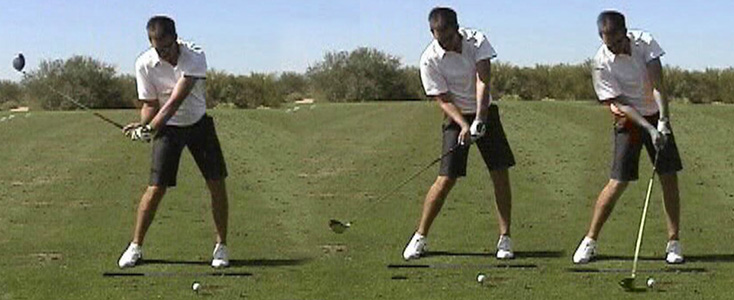
Yoda - look at that photo of Aaron Baddeley (in the post above this post)
Note that the clubshaft and hosel and clubface and flat left wrist/hand unit are all rotating at the same rpm (while the left wrist uncocks), and that there is no rotation of the hosel around the sweetspot in the downswing period between the delivery position and impact.




 Linear Mode


