It was point out (somewhere) that there is a design rule regarding location of the shaft relative to the club head. This is why we won't see shafts in-line with the COG (which would reduce unwanted flexing which varies with swing-speed and is a source of variability which adversely effecs accuracy).
Last edited by no_mind_golfer : 01-25-2009 at 02:49 PM.
Reason: clairification... misleading info deleted
From my perspective, the biomechanical movements of the torso/arms will be exactly the same if the clubhead has a width of 4", 8", 12" or 18" (presuming an identical club lie angle) because the essential need is to get the sole of the club parallel to the ground, and just touching the surface of the ground, at impact. In fact, if AK was swinging a dowel stick of the same length as his driver's clubshaft, but without a clubhead, his swing pattern (biomechanical movements) would likely remain the same as when he swings his regular driver. In all these cases, the hosel (and peripheral end of the dowel stick) would get to the same point at ground level. However, the distance of the hosel at its impact position from the ball-target line would depend on the width of the clubhead ( 50% of 4", 8", 12" or 18").
Regarding the COM (center-of-mass) question, it depends on the weight of the clubhead versus the clubshaft. Swinging an 18" wide clubhead may not be as easy or as fluid or as efficient or as biomechanically comfortable as swinging a 4" wide clubhead, but the clubshaft at impact must be on plane C, and a golfer must perform the standard biomechanical movements that AK performs to get it there - irrespective of the practical difficulties involved with dealing with the COM problem.
In that AK blue-lines example, one can draw a line between PP#3 and the sweetspot (which is 9" from the hosel). At impact, that sweetspot plane is much shallower than his clubshaft plane (plane C) at impact. If the club was swung post-impact onto that same sweetspot plane by the 4th parallel position, then AK would have to suddenly shallow his clubshaft plane post-impact while the clubshaft was traveling from impact to the 4th parallel (in order to rotate the clubshaft's hosel to the sweetspot plane). Can you imagine the "strange" biomechanical movements that would be necessary to achieve that goal?
I think there was an earlier post which asked that you take a club and hold it between your finger and thumb (top of the grip)and let it hang .Then rotate the grip back and forth.The shaft does not hang vertically.The clubshaft rotates around the sweetspot(as does the toe of the club),do you think this FACT will not occur when free swinging a club -with no clubface manipulation(ie horizontal hingeing)?
No... it doesn't happen during the swing. When the club is suspended the CG of the club seeks the low spot... That's where the ineria is minimized. when its twisted from this pos. , the hossel naturally rotates around the cog.
When swinging the club... force is imparted not the the cog but to the shaft through the grip. It would be leading (on the plane of the swing) and the Cog would naturally want to "fall in line" on the plane. The face would want to open not close. But because of golfer anatomy the wrists rotate on the downswing taking the face with (provided grip doesn't slip)
You wrote-: "Close your eyes and swing. That feeling, that weight at the end of the shaft feeling is the sweetspot, the longitudinal center of gravity. Not the shaft or merely the clubhead. We thrust that COG knowingly or unknowingly at the target (aiming point)."
I agree that if one swings with the eyes closed, that one can 'sense" the weight of the clubhead. However, I don't believe that one can precisely sense the sweetspot.
If a golfer thrusts (or throws) that "'clubhead weight" at the aiming point, without understanding human golf biomechanics, then he should expect shanks and/or all kinds of mishits. One needs to execute the "correct" biomechanical movements during the downswing i) to get the clubshaft to descend down to the ball on-plane and to ensure that the clubshaft at impact has the sole of the club parallel to the ground and touching the ground; ii) to get the clubface to swivel 90 degrees into impact during the release swivel phase (from the 3rd parallel position to impact) so that the clubface is square at the time of ball-clubface separation and iii) to get forward shaft lean at impact (FLW and bent right wrist). That is what "educated hands" is all about - moving the clubshaft and clubface "correctly" in space to achieve those goals. That's also what TGM is all about - precise biomechanics, precise mechanics, precise physics and precise geometry.
From my perspective, the biomechnaical movements of the torso/arms will be exactly the same if the clubhead has a width of 4", 8", 12" or 18" (presuming an identical club lie angle) because the essential need is to get the sole of the club parallel to the ground, and just touching the surface of the ground, at impact. In fact, if AK was swinging a dowel stick of the same length as his driver's clubshaft, but without a clubhead, his swing pattern (biomechanical movements) would likely remain the same as when he swings his regular driver. In all these cases, the hosel (and peripheral end of the dowel stick) would get to the same point at ground level. However, the distance of the hosel at its impact position from the sweetspot would depend on the width of the clubhead ( 50% of 4", 8", 12" or 18").
Jeff.
Jeff,
I always associate swing plane with swing force ... centrifugal, irrespective of the shaft, which can be crooked, bent. So in my thinking, AK should align his torso/arms to the force line linking the wrist swing center - PP#2 to the sweetspot X (the COM of the club should be on this line too) - I called this the virtual club shaft. AK should prepare to swing the virtual clubshaft not the real clubshaft.
Let's do a mental experiment with my high-school physics. Suppose we have access to a swing machine with a fixed swing axis and a fixed swing plane. Let's do two experiments with your golf club with the extra long-width clubhead:
1) Put the hosel of the shaft on the fixed swing plane; and
2) Put the COM of the whole club on the fixed swing plane.
In 1) the COM of the club will try to get on plane stressing the mechanical wrist joint to the point of breaking it. Unless they allow the off-plane hinging of the clubshaft, which is to allow the clubshaft to go off plane!
In 2) the swing will work out just fine except for the usual drooping of the clubhead and the associated bending of the clubshaft.
I think that you theoretical example has no relevance to a "real" golf swing.
Remember that the sole of the clubhead must lie flat against the ground at impact - irrespective of whether the clubhead width is 4", 8", 12" or 18". That's an absolute necessity. Therefore, that absolute requirement defines the exact clubshaft angle that must exist at impact - it depends on the club's lie angle.
A golfer must achieve that "correct" clubshaft plane angle at impact. To get to that "correct" clubshaft plane at impact in a very efficient manner, one simply has to perform the same biomechanical movements that Anthony Kim performs - whether the clubhead width is 4" or 8" or 12". Of course, the stresses and efficiency associated with swinging a 12" wide clubhead is going to very different when compared to swinging a 4" wide clubhead.
In my mental universe, Martin Hall has to swing his clubshaft along the plane board in order to keep the sole of his 12+" wide clubhead parallel to the ground at impact. You simply choose to ignore the need for the sole of his wide clubhead club to be parallel to the ground, and roughly on ground level, at impact.
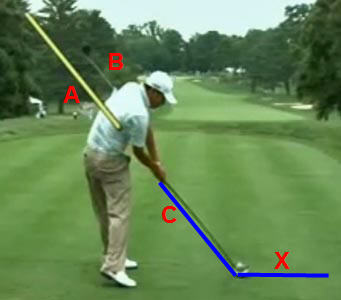
Consider this photo of Anthony Kim produced from the following swing video.
Swing video -
In this photo, A represents his clubshaft plane in the mid-downswing. B represents his clubshaft plane in the finish phase. Both A and B are on the same inclined plane as C ( C is his clubshaft plane at impact) because Anthony Kim has a perfectly symmetrical swing.
Now imagine Anthony Kim swinging a club that has a clubhead width of 18" and an identical club lie as his regular driver - represented by the blue lines. Point X is the sweetspot at impact and it is 9" from the hosel.
In my mental universe AK has to swing his club so that his clubshaft is exactly on plane C at impact - in order to get the sole of his 18' wide clubhead to be parallel to the ground at impact and just touching the surface of the ground at impact. In my mental universe, X rotates to B - in other words, the sweetspot rotates to the clubshaft plane at B (while the clubshaft simply remains on-plane between C and B).
Jeff.
Whether produced by Anthony Kim, Tiger Woods or a robot, an orbiting Sweetspot is indifferent to Lie Angle, i.e., the alignment of the Clubhead's sole (however long), at Impact. Or, for that matter, its alignment at any other selected point in the Sweetspot orbit. Hence the utility of cambered soles, long a fixture in modern golf club design.
Yoda - you wrote-: "an orbiting Sweetspot is indifferent to the alignment of the Clubhead's sole (however long) at Impact."
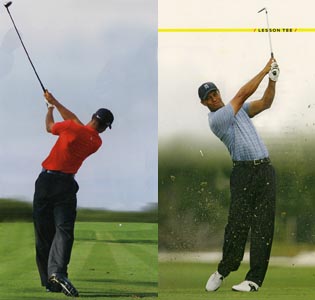
I agree with you. That's why swinging a golf club using your orbiting sweetspot model would not work that well with a clubhead width >4" where the clubhead sole is non-cambered. By contrast, the Anthony Kim swing model would work equally well with non-cambered soles and his swing model doesn't incorporate any "steering" actions. According to that AK swing model a golfer must generate a perfectly symmetrical swing where the clubshaft decends "on plane" from the TSP at the end-backswing to the elbow plane by the 3rd parallel, remains on the elbow plane from the 3rd parallel to the 4th parallel (as if it were running along the surface of a plane board inclined at an elbow plane angle), and then ascends gradually to the TSP again as the clubshaft moves "on plane" from the 4th parallel to a finish point on the TSP - as exemplified by Tiger Woods in these next photos.
If one swings in a perfectly symmetrical like Anthony Kim, and remains on the elbow plane through the entire impact zone between the 3rd and 4th parallel positions, then there is no "steering" actions occurring between the 3rd and 4th parallel positions. The clubhead arc will be perfectly symmetrical below waist level because the clubshaft simply travels on the surface of an imaginary plane that is inclined at the same plane angle as the elbow plane.
Yoda - you wrote-: "an orbiting Sweetspot is indifferent to the alignment of the Clubhead's sole (however long) at Impact."
I agree with you.
Good. I'm glad we got that out of the way.
Originally Posted by jeff
That's why swinging a golf club using your orbiting sweetspot model would not work that well with a clubhead width >4" where the clubhead sole is non-cambered.
Fortunately, the club manufacturers figured that out more than 100 years ago. Those old long-nosed wooden clubs they played with in the 19th century didn't last long. Sure were great for Horizontal Hinging, though, when that nose whipped around the Sweetspot! And they figured out cambering, too. Most golfers swing somewhere between the Elbow and Shoulder Planes, and the cambered sole allows the average golfer to raise the Toe or Heel a bit at address to accomodate his natural swing tendency (7-6).
Originally Posted by Jeff
By contrast, the Anthony Kim swing model would work equally well with non-cambered soles . . .
For all golfers (not just Anthony Kim), this is true only if the club's Lie Angle is exactly right. That's because, as we've both agreed above -- -- the orbiting Sweetspot is indifferent to the Lie Angle. If you build the Club you have postulated in your post #139 above . . .
. . . with a Clubhead 18" long with its Sweetspot (X) located in the middle of the Clubface (9" from the hosel), and you do not adjust the Lie Angle (C-X) to accomodate that moved Sweetspot (and consequently Flatter Sweetspot Plane Angle), then Mr. Kim, in spite of his considerable talents, is going to have a very rough go of it. Unless the shaft is stiff as a crowbar (which would raise a whole new set of issues), there will be a terrific amount of clubhead 'droop' through Impact. That's because Mr. Kim's educated Right Forearm and #3 Pressure Point will do their dead-level best to stay in line with the Sweetspot (X) and the Clubshaft must comply. As a result, I suspect you would see a lot of 'toe deep' divots and shouts of "Fore right!!"


 Wholeheartedly agree.....



 Linear Mode


