Here's a simple little experiment anyone can do (maybe not in the dead of winter though Next time you're cruising down the highway roll your window down. Stick your hand out holding it parallel to the highway. Now rotate it (slowly lest you break something) so your palm faces forward. Notice any difference? Of course you do.
In the golf swing with the club head goes from zero to 100+ (mph) in milliseconds. Do you realize what kind of drag an ordinary clubface experiences at 100+ mph? It ain't insignificant.
When its moving so darn fast why in the heck would the clubface want to turn into the wind? It wouldn't people... it would fall in line behind the shaft/hossel presenting the smallest possible frontal area to the wind (minimizing drag and maximizing entropy). Unfortunately (or fortunately depending on one's perspective) the club face has no choice in the matter. It does what the golfer's hands make it do.
BTW... frontal area is something to think about especially in these days of "game improvement" irons and mega-sized driver heads. Fine but you ain't gonna be able to swing-em as fast... because of drag (form and friction). That's just the way it is folks..
Last edited by no_mind_golfer : 01-25-2009 at 03:00 AM.
1) I attempted to illustrate my high-school understanding of Newton’s Laws of Motion with the tractor-trailer example that it takes a force to change the velocity (speed and direction) of a lump of mass. You are advocating the hosel moving in a the “clubshaft plane” while the relatively massive clubhead moving in and out and back in clubshaft plane. We then need to identify a force that makes the clubhead move like that which I find difficult to accept. Whereas I am advocating that the massive clubhead moves in plane or more precisely, the center of mass of the clubhead moves in a plane. This is like the center of mass of the skidding tractor/trailer moves in a straight line. Without other forces, the rotation if any is around the center of mass in both cases.
2) In your image of Aaron Baddeley in post #169, there are three combined actions from the left image to the right image
a) the release action of accumulator #4 – the swinging of the left arm
b) the release action of accumulator #2 – the wrist uncocking
c) the release action of accumulator #3 – the rotating of the left hand
The difficulty is that all three motions are occurring concurrently obscuring one another. But you can unravel them by doing them discretely one at a time in any sequence to get from the body posture of the left image to the body posture of the right image. Let do a) and then b) and stop. Now you can see that the clubface is near impact but severely open. Let fix our eyes on the clubhead and do c). You can now see the rotation of the hosel around the clubhead which is hidden when we do the actions concurrently.
Couldn't sleep (too much chili earlier) thought I share these thoughts.
Yoda is correct in saying the hossel and shaft rotate about the cg of the club head (not sweet spot). The discussion re. robots 10 pages ago had me thinking what was in question was the source... the cause, the raison d'être of the rotation (club face opening and closing). Do we all agree the hands (gears in the case of the robots) cause it? I hope so anyway...
Centripetal loading acting on the club head CG causes toe-down and forward deflection of the shaft as shown in the figure:
That centripetal loading (caused by centripetal acceleration not centrifugal) is reacted by the golfer's hands (primarily by the fatty palm area of the left hand in my opinion) at the butt of the grip. If we drew a line from the butt end of the grip to the CG of the club head, that is the axis of rotation that the torque (supplied by the golfer's hands) causes rotation about.
What I'm saying is the golfer CAUSES the rotation (about the "z" axis shown above) but it is the shaft and hossel that move the most (relative to that axis). They are farther away from it. Since the AXIS of rotation is through the CG of the club head (ON THE SWING PLANE) and the sweet spot in the face is close to that CG, it moves much less. The centripetal loading is similar to the second club shown on the link below. The axis of rotation is that dot-dash line.
You are advocating the hosel moving in a the “clubshaft plane” while the relatively massive clubhead moving in and out and back in clubshaft plane. We then need to identify a force that makes the clubhead move like that which I find difficult to accept."
You ask me to identify a force that causes the clubhead to move in space in a certain way.
The force that moves the club is the release of PA#4,2 and 3.
What you really need to understand is that the left hand grips the club firmly throughout the swing and the clubshaft's grip never swivel/rotates within the grasp of the left hand. Therefore, the clubface will always follow/duplicate the movement of the flat left wrist/hand throughout the stroke. In other words, the rotation of the back of the flat left wrist/hand causes the clubface and clubshaft to rotate in space at the same rpm as the rotating flat left wrist/hand. From the top of the swing to the 3rd parallel, the back of the flat left wrist/hand remains parallel to the inclined plane, and there is no rotation of the clubface or clubshaft. They are both in the same plane. From the 3rd parallel to impact, the flat left wrist/hand rotates 90 degrees into impact. Both the clubface and clubshaft rotate the same amount. Therefore, there can be no rotation of the hosel around the sweetspot (or vica versa). They move in different planes now (as perceived from a DTL view) because the clubhead has a fixed 90 degree relationship to the clubshaft, and the flat left wrist/hand is now rotating 90 degrees off the inclined plane so that it is perpendicular to the base of the inclined plane by impact.
You also wrote in 2c that the hosel rotates around the clubhead. It looks that way because you are keeping the clubshaft near-stationary. However, in reality both the sweetspot and hosel are rotating the same amount. If you really want to see the hosel rotating around the sweetspot, then loosen your left hand grip at that point and simply twirl-rotate the clubshaft 360 degrees around its longitudial axis (as if the clubshaft was suspended in a lathe) with your right hand twirling the butt end of the club. However, that never happens in a golf swing - the left hand grips the club firmly and the clubface and clubshaft only rotate as much as the left hand rotates in space. During the release swivel phase and the followthrough phase, the flat left wrist/hand and the clubface and hosel all rotate the same amount.
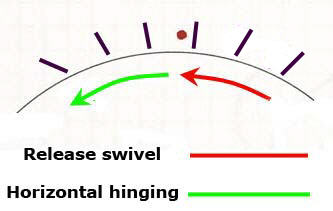
Consider the following diagram demonstrating the clubface rotation during the release swivel phase and the followthrough phase (using horizontal hinging).
Now, you may perceive the hosel or toe of the club rotating around the sweetspot in this diagram depicting the orientation of the clubface in space, but the reality is that both the toe and the heel of the club are rotating at the same rpm as the back of the flat left wrist/hand. The only reason why the toe "appears" to be rotating around the heel of the clubhead, is because it is further away from the axis of rotation of the rotating flat left wrist/hand. In reality, they are all rotating at the same rpm.
...The only reason why the toe "appears" to be rotating around the heel of the clubhead, is because it is further away from the axis of rotation of the rotating flat left wrist/hand. In reality, they are all rotating at the same rpm.
Jeff.
Precisely... all club parts rotate at the same angular velocity (which is relatively small) about an axis drawn from the grip to the CG of the club head where the net (integral ... sum total) of the centripetal acceleration is acting. Velocity is proportional to angular velocity and distance from the axis of rotation. Because the toe and hossel are farthest from this axis they move the fastest (toe towards target and hossel away from target). Because the "sweet spot" is close to this axis it moves very slowly no matter what. The notion that additional club-head speed can be had by rapidly closing the club face (as suggested by A.J. Bonar) is patently ridiculous. Rapid closing adds nil to club head sweet spot velocity at impact.
P.S.
That last statement is made with one small caveat... It may be possible that because of the fact that in a Bonar swing the club face presents a much lower frontal area (hence less aerodynamic drag) for a longer period of time, the golfer employing this method is able to generate a higher club head speed for a given ability to generate force. Lower aerodynamic drag longer = higher club head speed.
Last edited by no_mind_golfer : 01-25-2009 at 01:13 PM.
I have never disputed the fact that the hosel and clubshaft can rotate around the COG of the clubhead if the clubshaft is kept stationary and then simply rotated about the longitudinal axis of the clubshaft/clubhead combo - which is really the imaginary axis passing from the butt end of the club through the COG of the clubhead. I therefore can easily understand how a rotational torque force that torques the clubshaft around its combo longitudinal axis would cause the hosel to rotate relative to the COG of the clubhead.
"Precisely... all club parts rotate at the same angular velocity (which is relatively small) about an axis drawn from the grip to the CG of the club head where the net (integral ... sum total) of the centripetal acceleration is acting. Velocity is proportional to angular velocity and distance from the axis of rotation. Because the toe and hossel are farthest from this axis they move the fastest/ Because the "sweet spot" is close to this axis it moves very slow."
I disagree strongly with your depiction of events. During the release swivel phase and HH action phase of the swing, the different club parts are not rotating about the imaginary axis between the grip and the CG of the clubhead. What is happening is that the imaginary axis is moving in space due to movement of the flat left wrist/hand in space. The movement of the flat left wrist/hand occurs along a circular arc (relative to an imaginary center of the circle situated "somewhere" within space and all those parts (toe of the club, sweetspot of the club, hosel of the club) have the same angular velocity as the rotating flat left wrist/hand relative to the center of the imaginary circle. In other words, any point on that imaginary axis between the grip and the CG of the clubhead has the same angular velocity as the hosel and toe of the club - with respect to the instantaneous center of the imaginary circle of the flat left wrist/hand's rotational arc. The key point is "instantaneous" - if the flat left wrist/hand suddenly rotates along a tighter curve, then there must instantaneously be a different imaginary circle of rotation for all the rotating units (left hand, hosel, sweetspot, toe of the clubhead) which always have the same angular velocity relative to the center of that instantaeous imaginary circle of rotation. The only time that this system will breakdown is if the left wrist suddenly bends and doesn't remain flat.
I disagree strongly with your depiction of events. During the release swivel phase and HH action phase of the swing, the different club parts are not rotating about the imaginary axis between the grip and the CG of the clubhead. What is happening is that the imaginary axis is moving in space due to movement of the flat left wrist/hand in space. The movement of the flat left wrist/hand occurs along a circular arc (relative to an imaginary center of the circle situated "somewhere" within space and all those parts (toe of the club, sweetspot of the club, hosel of the club) have the same angular velocity as the rotating flat left wrist/hand relative to the center of the imaginary circle. In other words, any point on that imaginary axis between the grip and the CG of the clubhead has the same angular velocity as the hosel and toe of the club - with respect to the instantaneous center of the imaginary circle of the flat left wrist/hand's rotational arc. The key point is "instantaneous" - if the flat left wrist/hand suddenly rotates along a tighter curve, then there must instantaneously be a different imaginary circle of rotation for all the rotating units (left hand, hosel, sweetspot, toe of the clubhead) which always have the same angular velocity relative to the center of that instantaeous imaginary circle of rotation. The only time that this system will breakdown is if the left wrist suddenly bends and doesn't remain flat.
Jeff.
Nothing imaginary about it.
Sorry Jeff but...
(Now that I think I understand what is being argued here ...) I have to agree with Yoda and (probably Yodaslurk earlier) position(s). The physics cause the CG (call it sweet spot if you must) to remain stationary as the club twists about the Z axis (in MY diagram above). The CG is on the line of action of the centripetal acceleration.
Centripetal acceleration is a fact of life.... Its line of action (through the c.g. on the (instantaneous) plane of the golf swing, is the axis of rotation the club parts move about as a result of the golfer's hand torque.
Sometimes thing are best proven to one's self by experiment.
-Take a carpenter's square or some such thing.
-Tie a string to one end and the other end of the string to a door knob or something fixed.
-Take a bungee cord and attach one end of it to the middle (CG... sweet spot etc.) of the other leg of the carpenter's square.
-Have your assistant pull back on the bungee to simulate centripetal loading.
Now you give the thing a little twist. Observe ... what axis is it rotating about? That's right... the line of action of the bungee.. ie line of action of centripetal acceleration (less any adverse effects on the experiment due to gravity).
The club operates identical to this example in 3D.
Last edited by no_mind_golfer : 01-25-2009 at 02:14 PM.
This means there are 6 degrees of freedom (DOF) which fully describe the motion of any three dimensional object in it. They are 3 translations and three rotations. We're (me, myself and I) talking about only one of those 6 DOF's. We're talking about ROTATION about the Z axis in our arbitrarily defined golf swing coordinate system.
That Z axis is defined by a line through instaneous center of the instantaneous plane of rotation of the golf club. It just so happens that the COG of the Clubhead (by the very definition of centripetal acceleration resides (ALWAYS) on that instantaneous plane. Any club part that are not co-linear with said "line of action" will, when subject to a torque about said "Z" axis, move OFF OF the plane of the swing. Ergo... when the golfer's hands provide the torque which closes the club face, the hossel moves away from the target and the toe of the club moves towards the target OFF OF THE INSTANTANEOUS PLANE of the golf swing.
Jeff ... what you are saying is correct ONLY when the butt end of the grip where the golfer's hands are located, is not co-linear with the line of action of the instantaneous swing plane. During the release, for all practical purposes they share the same line of action.
Confusing as H*** isn't it.... The real difficulty is getting us all on the same page via type-written word.
Last edited by no_mind_golfer : 01-25-2009 at 02:41 PM.
Precisely... all club parts rotate at the same angular velocity (which is relatively small) about an axis drawn from the grip to the CG of the club head where the net (integral ... sum total) of the centripetal acceleration is acting. Velocity is proportional to angular velocity and distance from the axis of rotation. Because the toe and hossel are farthest from this axis they move the fastest (toe towards target and hossel away from target). Because the "sweet spot" is close to this axis it moves very slowly no matter what. The notion that additional club-head speed can be had by rapidly closing the club face (as suggested by A.J. Bonar) is patently ridiculous. Rapid closing adds nil to club head sweet spot velocity at impact.
P.S.
That last statement is made with one small caveat... It may be possible that because of the fact that in a Bonar swing the club face presents a much lower frontal area (hence less aerodynamic drag) for a longer period of time, the golfer employing this method is able to generate a higher club head speed for a given ability to generate force. Lower aerodynamic drag longer = higher club head speed.
i'm trying to decide if this is interesting or not . . . . how much velocity do you think is lost due to the drag? AND . . . . do you think it is worth popping a Bonar and risk sacrificing alignment of the face due to the thing swinging around like a screen door in a tornado?


 Next time you're cruising down the highway roll your window down. Stick your hand out holding it parallel to the highway. Now rotate it (slowly lest you break something) so your palm faces forward. Notice any difference? Of course you do.



 Linear Mode


