LynnBlakeGolf Forums

LynnBlakeGolf Forums (http://www.lynnblakegolf.com/forum/index.php)
-   The Clubhouse Lounge (http://www.lynnblakegolf.com/forum/forumdisplay.php?f=15)
-   -   On Plane Motion Practice (http://www.lynnblakegolf.com/forum/showthread.php?t=8765)

Daryl 12-13-2012 02:28 PM

Quote:

Originally Posted by O.B.Left (Post 94621)
Just re read this. You're changing my thinking on the less than 90 for balls back in stance. If you did what i was talking about (turned left , non turned right hand ) the right elbow would not be aligned for (passive or active) Right Arm thrust down the Delivery Line . It would be pointing target line wards. Its a very small thing but ..... precision golf demands precise alignments.

D, we need drawings. This stuff is the stuff of shot making. Me i square the face to the target line for balls back in the stance , draw shot resulting. For fades I move the ball forward , rotate my plane line left , left of my start line /face angle then swing along the plane line ... with a hold off angled hinge. (Lets be honest here) Straight shots ? The hardest shot in golf ? Experiment and compare your results . I dont try to hit em. Using these procedures the fade goes high , soft given more loft at Fix and the layback of Angled etc . The Draw is harder lower typically . You can adjust the release point to change the traj.

This is what I want to talk about ... lets start a thread using Homers book references. Tilted backspin, divergence between path and face angle, angle of attack, less out for steeper lie /plane angles , plane line rotation vs face rotation ....

I agree that this needs a new thread. Start one and I'll post there.

If you want to hit a straight shot with a ball played 6 inches aft of Low Point, then steepen the plane. The ball is moved back on the orbit (not on the plane line). Moving it back on orbit will raise the ball above ground, so steepen the plane from the Plane reference point on your body (shoulder or hip). Then, you're not changing Low Point Location but you are substantially reducing the Clubheads Angle of Approach. Homer said 'move the ball back toward your right foot (see illustration #3 and #4). When you move the ball back on the plane line you're creating additional divergence and you need to pivot or align differently or swing cross line to intersect the ball, illustration #2.

Why do players move the ball back on the Plane Line, when all that does is create more divergence? Besides, moving it back on the Plane Line moves the ball away from the Clubhead Orbit, see illustration #2.
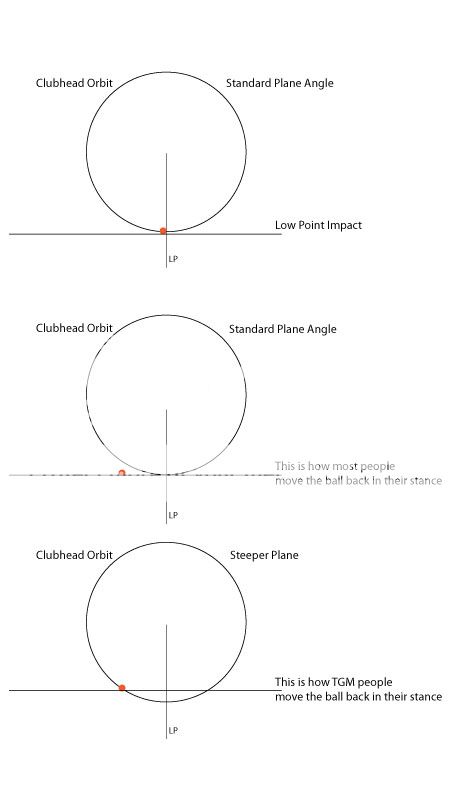
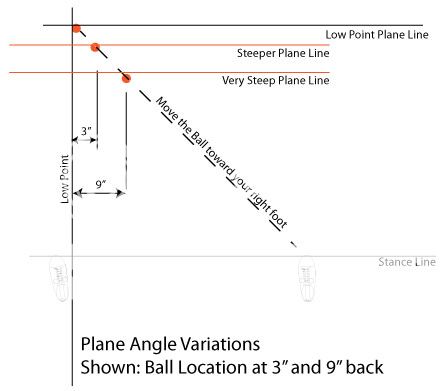


Moving the ball back more than 9 inches (maybe 9" is too far) would result in having the Toe of the club Strike the ground first. So there is a limit to how far back the ball can be played while still hitting a straight shot. It may be only 4-6" for a clean pick-off.

Of course, all of this assumes that you're using the "Right Forearm Angle of Approach" and not using a Hand Swivel at Impact. Also, when Homer said to move the Ball toward your right foot, he was giving a fast way to locate the plane angle. This should work for most people but its only a guideline. The right forearm angle of approach will give you the exact location each time but I find moving it back toward your right foot a pretty good quick method substitute.

HungryBear 12-13-2012 07:32 PM

Quote:

Originally Posted by Daryl (Post 94622)
I agree that this needs a new thread. Start one and I'll post there.

If you want to hit a straight shot with a ball played 6 inches aft of Low Point, then steepen the plane. The ball is moved back on the orbit (not on the plane line). Moving it back on orbit will raise the ball above ground, so steepen the plane from the Plane reference point on your body (shoulder or hip). Then, you're not changing Low Point Location but you are substantially reducing the Clubheads Angle of Approach. Homer said 'move the ball back toward your right foot (see illustration #3 and #4). When you move the ball back on the plane line you're creating additional divergence and you need to pivot or align differently or swing cross line to intersect the ball, illustration #2.

Why do players move the ball back on the Plane Line, when all that does is create more divergence? Besides, moving it back on the Plane Line moves the ball away from the Clubhead Orbit, see illustration #2.


Moving the ball back more than 9 inches (maybe 9" is too far) would result in having the Toe of the club Strike the ground first. So there is a limit to how far back the ball can be played while still hitting a straight shot. It may be only 4-6" for a clean pick-off.

Of course, all of this assumes that you're using the "Right Forearm Angle of Approach" and not using a Hand Swivel at Impact. Also, when Homer said to move the Ball toward your right foot, he was giving a fast way to locate the plane angle. This should work for most people but its only a guideline. The right forearm angle of approach will give you the exact location each time but I find moving it back toward your right foot a pretty good quick method substitute.

Five Lessons, page 125, Hogan's ball location(s), same geometry with rotated plane line?

HB

O.B.Left 12-13-2012 08:06 PM

Quote:

Originally Posted by HungryBear (Post 94625)
Five Lessons, page 125, Hogan's ball location(s), same geometry with rotated plane line?

HB

Let's take this to a new thread . Great question and IMO answer is no!

innercityteacher 12-13-2012 09:23 PM

Totally new information! Wow!
 
Quote:

Originally Posted by Daryl (Post 94622)
I agree that this needs a new thread. Start one and I'll post there.

If you want to hit a straight shot with a ball played 6 inches aft of Low Point, then steepen the plane. The ball is moved back on the orbit (not on the plane line). Moving it back on orbit will raise the ball above ground, so steepen the plane from the Plane reference point on your body (shoulder or hip). Then, you're not changing Low Point Location but you are substantially reducing the Clubheads Angle of Approach. Homer said 'move the ball back toward your right foot (see illustration #3 and #4). When you move the ball back on the plane line you're creating additional divergence and you need to pivot or align differently or swing cross line to intersect the ball, illustration #2.

Why do players move the ball back on the Plane Line, when all that does is create more divergence? Besides, moving it back on the Plane Line moves the ball away from the Clubhead Orbit, see illustration #2.


Moving the ball back more than 9 inches (maybe 9" is too far) would result in having the Toe of the club Strike the ground first. So there is a limit to how far back the ball can be played while still hitting a straight shot. It may be only 4-6" for a clean pick-off.

Of course, all of this assumes that you're using the "Right Forearm Angle of Approach" and not using a Hand Swivel at Impact. Also, when Homer said to move the Ball toward your right foot, he was giving a fast way to locate the plane angle. This should work for most people but its only a guideline. The right forearm angle of approach will give you the exact location each time but I find moving it back toward your right foot a pretty good quick method substitute.

I did not know this, always wondered why really good players had the ball so far back toward the right foot! WOW! :hello2:

ICT

O.B.Left 12-14-2012 02:25 PM

D I think you took "towards the right foot" too literally. I dont where Homer said this but I would take it to mean laterally rather diagonally.

Shorter sticks require more upright lie angles however which does lead to a more upright plane angle , that and the abreviated backswing (less back up and IN for a shorter backswing) . Which translates into less OUT more Down , steeper Angle of Attack, less "side spin" (tilted backspin) more backspin. IMO, you can maintain shaft plane while moving the ball back with a singular club in hand.

Lets go to a new thread.

Daryl 12-14-2012 02:38 PM

Quote:

Originally Posted by O.B.Left (Post 94634)
D I think you took "towards the right foot" too literally. I dont where Homer said this but I would take it to mean laterally rather diagonally.

Shorter sticks require more upright lie angles however which does lead to a more upright plane angle , that and the abreviated backswing (less back up and IN for a shorter backswing) . Which translates into less OUT more Down , steeper Angle of Attack, less "side spin" (tilted backspin) more backspin. IMO, you can maintain shaft plane while moving the ball back with a singular club in hand.

Lets go to a new thread.

Ya, I used to think that too. It jives too well with chapter 2. So I'm believing it. Besides, he was too careful. He picked every word. Why not just say "Aft" on the Plane line.

HungryBear 12-14-2012 03:00 PM

Quote:

Originally Posted by O.B.Left (Post 94634)
D I think you took "towards the right foot" too literally. I dont where Homer said this but I would take it to mean laterally rather diagonally.

Shorter sticks require more upright lie angles however which does lead to a more upright plane angle , that and the abreviated backswing (less back up and IN for a shorter backswing) . Which translates into less OUT more Down , steeper Angle of Attack, less "side spin" (tilted backspin) more backspin. IMO, you can maintain shaft plane while moving the ball back with a singular club in hand.

Lets go to a new thread.

I would like to comment, but, not till U start a new thread. Dare U, Double Dare!

HB

O.B.Left 12-14-2012 07:11 PM

Yes up plane which back in up as opposed to straight line laterally .

Bear I did start a thread. Dare you to draw a circle with a center radius and low point plane line. Or maybe Daryl has some drawings like that . Tbd.


All times are GMT -4. The time now is 10:37 AM.